
Listening Is the Moat
Information used to be scarce.
If you had better access to customers, better market reports, better analytics, or better distribution, you could know things your competitors did not. That gap mattered. It gave teams time to act before everyone else caught up.
That world is disappearing.
Today, most teams can get access to more information than they know what to do with. Analytics are everywhere. Session recordings are everywhere. Survey tools are everywhere. Public reviews, community posts, sales calls, support tickets, employee feedback, partner notes, and competitor pages are all a few clicks away. AI makes even more of it searchable, summarized, and instantly available.
But availability is not understanding.
The teams that win from here will not be the ones with the most dashboards. They will be the ones that listen better. They will build a deeper relationship with the people they serve, notice the signal inside messy conversations, and turn that signal into better decisions faster than anyone else.
That is the moat.
The Problem With Listening Today
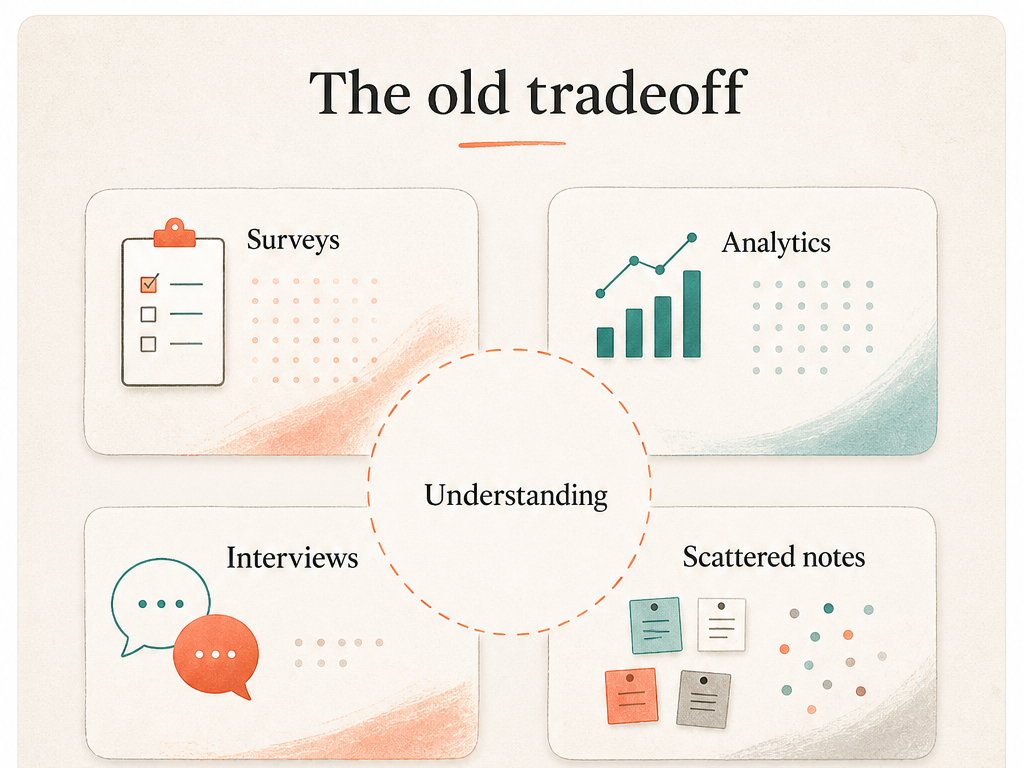
Every team says it wants to be customer obsessed. Almost every team has some version of a listening stack. The problem is that most listening methods force a tradeoff between depth and scale.
Surveys scale, but they flatten people.
They are useful for measuring known questions. They are weak at discovering the question you did not know to ask. A person can select a score, click a reason, and still leave behind the most important part: the hesitation, the contradiction, the workaround, the emotional context, the sentence that would have changed your next decision if someone had been there to ask a follow-up.
Analytics scale too, but they mostly show what happened.
Funnels, cohorts, retention curves, and operational metrics are essential. They tell you where behavior changes. They do not tell you, on their own, what the experience felt like from the inside. They can show that people dropped off, escalated, churned, stalled, disengaged, or hesitated. They cannot always tell you whether the cause was confusion, distrust, low urgency, broken expectations, missing language, or a need your organization never truly understood.
Interviews give you depth, but they do not scale easily.
A great founder, operator, leader, or researcher can hear the thing beneath the thing. They can follow a thread, pause at the right moment, ask why a word mattered, and turn a conversation into insight. But scheduling, conducting, transcribing, synthesizing, and sharing interviews is expensive. Because of that cost, deep listening often becomes occasional. It becomes a sprint, a research project, an internal listening tour, or a few calls before a launch instead of a constant operating rhythm.
Support tickets, sales notes, employee comments, partner conversations, community posts, and social listening add more texture, but they are fragmented.
Each channel is biased by the moment that created it. Support hears pain when something breaks. Sales hears objections under buying pressure. Internal feedback often arrives through hierarchy, timing, and politics. Social channels overrepresent the loudest voices. None of that makes the signal useless. It means the signal needs context, structure, and a way to connect back to the questions the team is actually trying to answer.
So teams end up with a strange situation: more information from customers, users, employees, prospects, and partners than ever, and still not enough understanding.
Depth at Scale
The real unlock is not replacing human judgment. It is giving teams a way to collect more of the conversations that make judgment better.
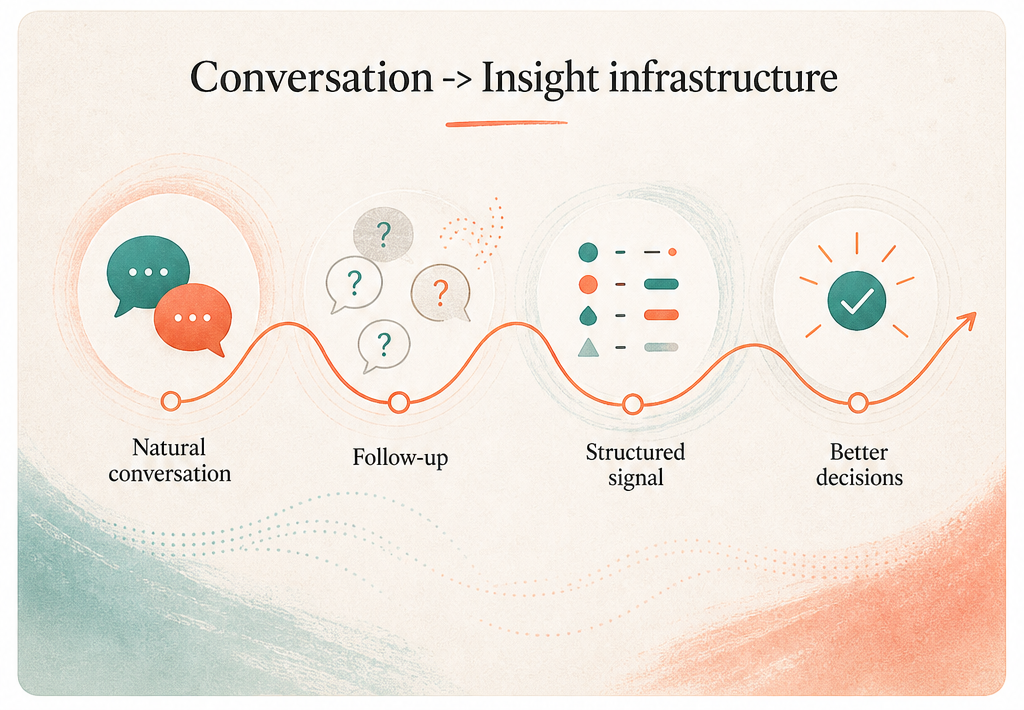
Depth at scale means someone can speak naturally, in their own words, while the system still captures structured signal. It means listening does not stop at the first answer. It follows up. It hears uncertainty. It notices the difference between a stated preference and an actual struggle. It turns qualitative conversations into evidence that teams can revisit, compare, and act on.
This matters because the most useful insights rarely arrive as clean requests.
People do not always know how to name their problem. They describe symptoms. They jump between stories. They contradict themselves. They soften criticism. They ask for one solution when the real issue is trust, timing, comprehension, motivation, or workflow fit.
Good listening creates enough space for that truth to surface.
The challenge is that most companies cannot have that kind of conversation with every customer, user, prospect, churned account, employee, partner, community member, or visitor who has something useful to say.
That is where we think the category needs to move.
Listening should become infrastructure.
Not a one-off research motion. Not a pile of transcripts waiting for someone to read them. Not a survey that pretends nuance can fit into a dropdown. Infrastructure: always available, embedded where conversations already happen, able to hold a natural exchange, and designed to turn those conversations into structured insight for the team.
Why We Built Stetos.co
Stetos.co is insight infrastructure for teams that want to listen at scale.
With Stetos.co, teams can deploy AI listening agents over voice or chat. Those agents can live on a page, be shared through a link, or be embedded where feedback naturally happens. They do not just collect form responses. They hold conversations, ask follow-up questions, and help teams understand what people actually mean.
After each conversation, Stetos.co turns the raw exchange into structured insight: summaries, themes, signals, scores, evidence, and outputs that teams can use without losing the original human context.
The goal is simple: make deep listening easier to run continuously.
For a founder, that might mean understanding why visitors hesitate before signing up. For a product leader, it might mean hearing what users really think about a new workflow. For a people leader, it might mean giving employees a safer way to describe friction inside the company. For a go-to-market team, it might mean capturing the language, doubts, and moments of excitement that never show up in analytics alone.
The world does not need another dashboard full of disconnected data. It needs better ways to hear people.
We Are Live on Product Hunt
Today, we are launching Stetos.co on Product Hunt.
If this idea resonates with you, we would love for you to check it out, try the product, and support the launch. More importantly, we would love to hear what you think.
You can also try the live demo here: Talk to the Stetos.co demo agent. We are sharing Product Hunt launch promo codes with people who try it and want to keep listening at scale.
Because that is the whole point.
The companies that listen closer will learn faster. The companies that learn faster will build better. And as information becomes easier for everyone to access, the depth of your listening may become one of the few advantages that is still hard to copy.

Stetos.co
Insight infrastructure. Listen at scale.